


BAY AREA
PICKLEBALL COURT
RESURFACING
BAY AREA PICKLEBALL COURT RESURFACING
CONTEMPORARY COURTS
MODERN METHODS
CONTEMPORARY COURTS
MODERN METHODS

WHY BAY AREA CUSTOMERS CHOOSE US FOR
PICKLEBALL COURT RESURFACING

Member of the American Sports Builders Association (ASBA), the national authority for court construction and surfacing.
- Precision Craftsmanship - Courts built to ASBA recommended specifications.
- Direct Access - Work directly with the owner from start to finish. No handoffs to sales reps or project managers.
- Premium Acrylic System - Tournament grade coatings applied at proper mix ratios and no over-dilution for rich colors and sharp lines.
- Trained, In-House Technicians - All resurfacing performed by our own team, ensuring consistency, accountability, and craftsmanship at every step.
- Licensed General Contractor - bonded, insured, and able to handle complete sports construction and surfacing.
- Clean, Transparent Process - Clear communication, clean job sites, and meticulous execution with no shortcuts.
- Independent - Not a Franchise - Bay Area based, locally owned and focused solely on high performance sports surfaces.

TRUSTED AND RECOGNIZED


Best of Houzz – Three Years in a Row
Featured in the San Francisco Chronicle
PICKLEBALL COURT RESURFACING

If your pickleball court is worn, cracked, or fading, we will restore it to a clean, high performance surface built to last. Our resurfacing work includes crack repairs, leveling low and high areas, correcting surface texture, and applying acrylic color coatings that improve traction and ball response. We address the root causes of wear so your court not only looks new but plays consistently for years.
Typical resurfacing work includes:
- Crack repair with optional crack reinforcement overlays
- Filling low areas and removing high areas
- Applying a filler coat to restore uniform texture
- Premium acrylic color coatings in your chosen design
- Precision line striping to USA Pickleball standards
- Optional upgrades such as a crack membrane systems or a cushioned court
UNDERSTANDING CRACKS ON PICKLEBALL COURTS
Before resurfacing, many customers ask the same questions:
“Is this crack serious?”
“Is this fixable?”
“Do I need a full rebuild?”
Most cracks can be repaired and resurfaced, but it’s important to understand expectations. Even with proper repairs, an older court with a history of cracking will never look or perform exactly like a brand new court. Repairs will greatly improve performance and appearance, but they cannot fully eliminate the underlying movement in the base. Below are the most common crack types we see on pickleball courts and what they usually mean for resurfacing.
- Hairline cracks – narrow cracks with no separation between the sides of the crack, that have no elevation change on either side. Caused by shrinkage cracks, aging of the base, or surface wear. These are minor and can be filled and coated with very good results.
- Structural cracks – cracks large than 1/8″ that remain level on both sides. Usually the result of aging asphalt or mild base movement. They can be filled and resurfaced, and performance improves dramatically. But long term recurrence is still possible, especially on older asphalt.
- Severe elevation cracks – these are cracks where one side is higher or lower than the other. These are usually caused by soil movement or tree roots. These cannot be repaired with fillers. These areas typically require removing and rebuilding the base. Without rebuilding, the cracks will likely return.
- Settlement cracks (edge slumping) – Common on older asphalt court when the perimeter sub base fails and sinks. The outer edge slopes downward, creating cracks and uneven areas. These areas often need removal of the damaged areas and replacement before resurfacing.
- Spider or Alligator cracking – A dense web of interconnected cracks caused by asphalt oxidation or widespread surface fatigue. Repairs can restore appearance and playability, but spier cracked areas may show texture differences over time.
- Radial cracking around net posts – Circular or radiating cracks around net post footings. Caused by the concrete footing expanding and contracting differently than the asphalt or slab around it. These cracks can be filled, and the footing leveled, but slight outlines may still reappear over time.
TYPICAL REPAIRS BEFORE RESURFACING PICKLEBALL COURTS

Before resurfacing, we evaluate the court for structural and cosmetic issues that will affect how long the new surface lasts. Proper repairs ensure the acrylic system bonds correctly and prevents problems from returning.
Typical repair work includes:
- Crack repair – from hairline cracks to wider structural cracks caused by movement, where the base elevation remains consistent.
- Severe crack repair – areas with severe soil movement may require cutting out damaged sections or rebuilding parts of the base
- Heaving – commonly caused by tree roots, affected areas must be removed and rebuilt to restore proper elevations.
- Low areas (birdbaths) – depressions deeper than 1/16″ must be leveled to ensure drainage and consistent ball bounce.
- High areas – raised or uneven high areas are mechanically grinded flat for a uniform playing surface.
- Surface texture correction – overly smooth concrete or worn surfaces are prepared so the coatings bond correctly.
- Coating failure or discoloration – peeling, flaking, or discolored areas are removed and patched to prevent future failure.
- Radial cracking around net post footings – caused by differential expansion of the concrete footing against the asphalt surrounding it. We fill the cracks and level out the concrete if it is not even with the court surface.
- Surface preparation – the entire court is pressure washed and cleaned to remove dirt to ensure maximum adhesion of the acrylic coatings.
CRACK REINFORCEMENT MEMBRANE SYSTEMS
For courts with recurring or active cracks, we offer optional crack reinforcement membranes designed to reduce the visibility of future movement. These systems don’t stop structural shifting within the slab, but they absorb minor expansion and contraction, helping prevent cracks from immediately relfe ting back through the acrylic coatings.
Crack membranes are ideal for older asphalt or concrete, courts built without proper subgrade prep, or surfaces with known crack history – and they significantly extend the lifespan of crack repairs. Benefits include:
- Helps reduce cracks telegraphing through to the surface
- Adds flexibility to absorb minor movement in the base
- Extends the lifespan of the acrylic surface
REPLACING NET POSTS BEFORE RESURFACING
Many older pickleball courts have leaning, rusted, loose, or incorrectly placed net posts. Because the net posts are set in concrete footings beneath the surface, the ideal time to replace them is before resurfacing, not after. Once the new acrylic coatings are installed, cutting into them later will result in visible patching and color inconsistencies.
Pickleball may seem simple, but the entire game depends on a stable, properly installed net system. The height, tension, and placement of the net directly affects ball trajectory, gameplay fairness, and even player safety. When you’re investing in resurfacing, it may make sense to replace an outdated net system.
Common issues we see with older net posts:
- Leaning or loose net posts – caused by deteriorating footings or rusted sleeves
- Incorrect post height – caused when post is not properly braced, and sinks into wet concrete. This causes incorrect net height.
- Concrete footing too high or low – leading to poor drainage and radial cracking around net posts
- Cosmetic mismatch – sometimes the structure is fine, but the posts are old, faded and damaged, and won’t look good next to a brand new resurfaced court. We will also replace your old worn out net along with the net posts.
Our net post replacement process:
- Demo the existing post and footing
- Install a new ground sleeve in concrete at the correct elevations
- Patch and level the surrounding surface so the new acrylic coating finishes cleanly.
Why replace posts before resurfacing?
- Prevents future cracking around old or failing footings.
- Ensures the correct net tension and net height for better performance.
- Creates a clean uniform look on the finished court.
- Avoid cutting into the newly resurfaced court later, which will be impossible to hide later.
SURFACING NEW PICKLEBALL COURTS
If you have recenly built a new concrete or asphalt slab – whether by contractor, landscaper, or your own construction team – we handle all surface prep, color application, and final finishing needed to turn it into a quality pickleball court. Our finishing system is designed to bond properly to new slabs, protect the surface, and deliver a durable, attractive playing surface.
New court surfacing typically includes:
- Surface cleaning and substrate preparation
- Filling any existing concrete control joints to ensure a flat base
- Acrylic resurfacer to even out the texture, and to seal the concrete or asphalt
- Two coat color surfacing in your chosen design
- Precision line striping to USA Pickleball standards
- Optional upgrades like cushion courts
IMPORTANT CONSIDERATIONSWHEN BUILDING YOUR OWN CONCRETE SLAB
If you are building your own slab, here are the most common issues we see that can affect resurfacing later.
- No vapor barrier installed. Moisture migrates up the slab, causing bubbling, discoloration, and delamination of acrylic coatings. Plastic sheeting is not the same as a vapor barrier. You need a Class A vapor barrier (10 mils thickness minimum), properly taped at the seams. Punctures during the pour must be sealed or vapor pressure problems will occur even with the correct vapor barrier.
- Concrete finished too smooth. A steel troweled finish it soo smooth for acrylic coatings to bond to and may lead to peeling. We recommend a medium broom finish, roughly CSP 2-3.
- Incorrect slope. Courts must slope 1% for proper drainage. Incorrect slope can trap water and lead to long term problems with low areas and surface failures.
- Low spots. Any area deeper than 1/16″ is considered a defect and must be leveled before surfacing.
- Control joints. For best results, concrete should be poured without control joints whenever possible. These joints tend to become future crack lines even after they are filled.
CUSHIONED PICKLEBALL COURT SURFACING
A cushioned pickleball court is a premium upgrade that adds a shock absorbing mat layer beneath the acrylic color coatings. We use a prefabricated cushion mat system designed specifically for courts. This mat provides a consistent level of shock absorption across the entire surface and delivers a noticeably softer, more comfortable feel during play. The cushion reduces joint impact, improves comfort on longer rallies, and creates a smoother more controlled playing experience – all while maintaining consistent ball bounce.
A cushion court is ideal for:
- Players with knee, hip or back sensitivities
- Players seeking a lower impact surface.
- Customers who want a premium play experience.
- Clubs, HOAs and facilities upgrading amenities.
Because the cushion is a mat, it also helps mask minor surface imperfections and creates a more uniform texture before the acrylic layers are applied. A mat cushion typically lasts 10-15+ years depending on UV exposure and usage. During future resurfacing cycles, only the top color coats need renewing – the mat remains in place. The mat can be installed over existing courts as long as the base is repaired cirst and the slab is level.
WHY WE PREFER MAT CUSHIONS OVER LIQUID APPLIED CUSHIONS
There are two common cushion approaches used in the court surfacing industry:
- Liquid applied rubber cushion
- Prefabricated mat based cushion
While both soften the surface, we believe mat cushion systems deliver a more consistent and durable result for pickleball. Here’s why:
- Uniform thickness across the entire court – liquid cushions are applied by hand, which means the thickness varies across the playing surface. A mat cushion has a precise, factory controlled thickness, so the surface feels the same everywhere you move.
- Better long term durability – liquid applied cushions are thin and can wear down over time. Mat systems are tougher, less prone to abrasion, and maintain their performance longer.
- Better ball response – because mats stay uniform, they help maintain a consistent ball bounce.
Liquid applied cushions are widely used because they are easier to install. Contractors can apply multiple layers with the same squeegees they already have for resurfacing. This makes liquid cushions an easy add on for most installers and keeps materials costs relatively low.
Mat cushions on the other hand use a rubberized mat that provides a more consistent and longer lasting cushion layer. The material cost is higher, but the labor is actually lower. Mat systems roll out quickly, cover imperfections more uniformly, and eliminate the need for building up multiple liquid coats. However, mat cushions require specialized training to install properly. Achieving good seams, proper layout, and full adhesion takes experience. And many resurfacing companies do not offer mat systems for this reason.
The trade off is clear:
- Liquid cushions – lower cost, easier to install, widely available.
- Mat cushion – higher performance, more consistent feel, less labor but more installer skill required.
By offering mat cushion system, we provide an upgraded cushion option over liquid applied cushions.
FREQUENTLY ASKED QUESTIONS ABOUTPICKLEBALL COURT RESURFACING
Cracks that are caused by asphalt or slab movement can return, even after professional repair. Acrylic coatings cannot stop structural shifting within the concrete or asphalt. Standard crack repairs can hide existing cracks, but movement in the base can cause the cracks to reflect back through the new surface over time. For courts with recurring cracks, we recommend a crack reinforcement membrane to reduce crack telegraphing.
The lifespan of a pickleball court depends on the condition and stability of the base. New concrete slabs: typically 6-10 years when properly built with vapor barrier, medium broom finish, and no movement. These courts hold acrylic coatings the longest. New asphalt: usually 5-7 years, depending on compaction and weather exposure. Asphalt is softer than concrete and as it ages becomes more brittle and prone to cracking. Older asphalt with movement or existing cracks: lifespan is often 3-5 years, especially if the base is moving, has tree roots, or a poor subgrade. Crack repairs can delay crack reflection but cannot stop base movement. Courts with recurring structural cracks: lifespan varies. Even with professional repair and a crack membrane, movement in the base can cause cracks to return over time. Membranes help extend surface life by reducing crack telegraphing.
If your court shows fading, worn texture, cracking, puddling, or peeling coatings, it usually requires full resurfacing. Small isolated issues can sometimes be spot repaired, but uneven texture, widespread cracks, or drainage problems indicate it is time for resurfacing. Spot repairs will also not blend in with the rest of the court and look ugly.
Yes. Low spots deeper than 1/16″ are filled before resurfacing to restore proper drainage and ball bounce. Persistent drainage issues may require additional corrections to the base before the acrylic system is applied.
Yes, but more extensive repair work may be needed. Severe cracks, heaving from tree roots, or unstable soil may require removing and rebuilding sections of the court before the surfacing system is installed. We will assess the base and provide repair recommendations.
A standard two color pickleball court typically take 4-5 days. If there are repairs needed, then there will be additional time needed depending on how many repairs are needed.
Yes. Acrylic coatings require daytime highs around 55-60 degrees, and overnight lows above 50 degrees to cure properly. Cooler temperatures increase drying time and may cause color variation. We cannot do any surfacing in December and January. Select days in February may be possible.
Yes, some work can still be done in winter even when it is too cold to apply acrylic coatings. We can typically complete:
- Net post installation or replacement
- Concrete patching and leveling work
- Cutting out and rebuilding failed sections
- Grinding high spots
- Crack routing and structural crack preparation.
These repairs are not temperature sensitive like acrylic color coatings. Once warmer weather arrives (typically March-April) we can return to apply the resurfacing and color coatings.
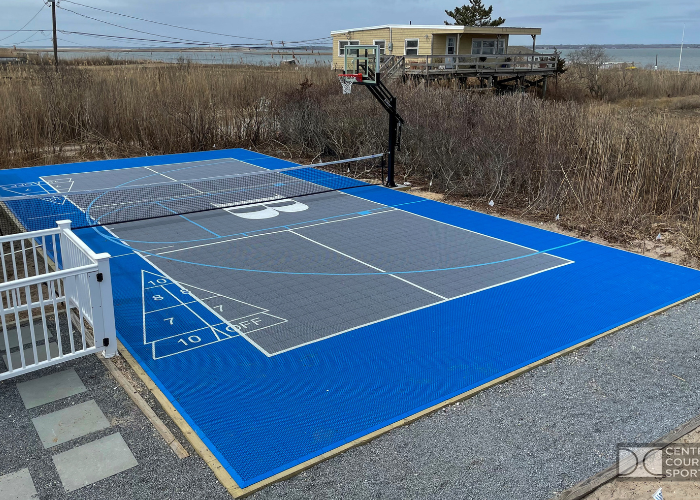
BACKYARD PICKLEBALL COURT PHOTOS



PICKLEBALL COURT DIMENSIONS
Most dedicated courts are built at 30’ × 60’, which provides: 5 feet of space behind each baseline and 5 feet along each sideline. If you have extra room, many players prefer a 30’ × 64’ or 34′ x 64′ layout for additional depth behind the baselines—especially for competitive or fast-paced play.
We evaluate your available space, access, and any obstructions to design the largest and safest layout your property allows. Our goal is always a court that meets standards, plays comfortably, and fits your site cleanly.
A regulation pickleball court has fixed in-bounds dimensions of 20’ × 44’. To play comfortably, the court also needs out-of-bounds space around all sides. This out-of-bounds area allows room for serves, returns, and safe movement near the lines.
Most dedicated courts are built at 30’ × 60’, which provides: 5 feet of space behind each baseline and 5 feet along each sideline. If you have extra room, many players prefer a 30’ × 64’ or 34′ x 64′ layout for additional depth behind the baselines—especially for competitive or fast-paced play.
We evaluate your available space, access, and any obstructions to design the largest and safest layout your property allows. Our goal is always a court that meets standards, plays comfortably, and fits your site cleanly.
A regulation pickleball court has fixed in-bounds dimensions of 20’ × 44’. To play comfortably, the court also needs out-of-bounds space around all sides. This out-of-bounds area allows room for serves, returns, and safe movement near the lines.
Most dedicated courts are built at 30’ × 60’, which provides: 5 feet of space behind each baseline and 5 feet along each sideline. If you have extra room, many players prefer a 30’ × 64’ or 34′ x 64′ layout for additional depth behind the baselines—especially for competitive or fast-paced play.
We evaluate your available space, access, and any obstructions to design the largest and safest layout your property allows. Our goal is always a court that meets standards, plays comfortably, and fits your site cleanly.

Pickleball court size
recommended by USA Pickleball
30’W x 60’L
court size for backyard residential courts
and commercial courts
34’W x 64’L
court size for competitive play
and more comfortable recreational play
(as shown above)

Reduced pickleball court size
28’W x 55’L
minimum suggested size
for a backyard court
50′ long court would likely require stepping
off the court to play a ball. Less than 50′ long court
would result in non regulation court lines.
(28′ x 50′ as shown above)
BACKYARD PICKLEBALL COURT FENCING

Court fencing available. Full construction details will be available soon. Contact us for information.
BACKYARD PICKLEBALL COURT LIGHTING

We also install court lighting. Full details will be available soon. Contact us for information.

