BAY AREA
BASKETBALL COURT RESURFACING

BAY AREA BASKETBALL COURT RESURFACING

CONTEMPORARY COURTS
MODERN METHODS

CONTEMPORARY COURTS
MODERN METHODS

WHY BAY AREA CUSTOMERS CHOOSE US FOR
BASKETBALL COURT RESURFACING

american sports builders association

Member of the American Sports Builders Association (ASBA), the national authority for court construction and surfacing.

TRUSTED AND RECOGNIZED

best of houzz 2025
san francisco chronicle

Best of Houzz – Three Years in a Row

Featured in the San Francisco Chronicle

BASKETBALL COURT RESURFACING

pickleball court resurfacing

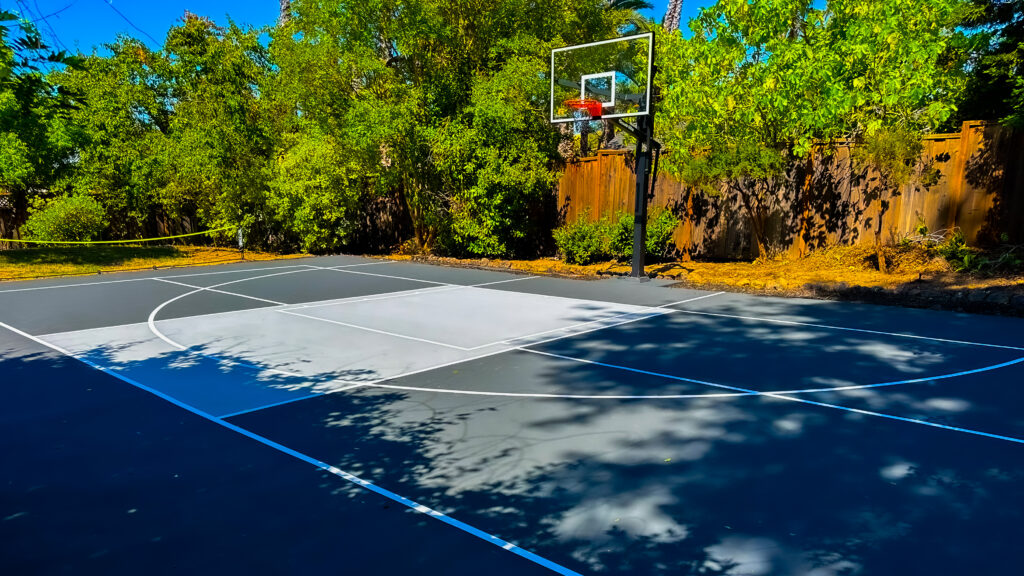
If your basketball court is worn, cracked, or fading, we will restore it to a clean, high performance surface built to last.  Our resurfacing work includes crack repairs, leveling low and high areas, correcting surface texture, and applying acrylic color coatings that improve traction and ball response.  We address the root causes of wear so your court not only looks new but plays consistently for years.

Typical resurfacing work includes:

  • Crack repair with optional crack reinforcement overlays
  • Filling low areas and removing high areas
  • Applying a filler coat to restore uniform texture
  • Premium acrylic color coatings in your chosen design
  • Precision line striping

UNDERSTANDING CRACKS ON BASKETBALL COURTS

Before resurfacing, many customers ask the same questions:
“Is this crack serious?”
“Is this fixable?”
“Do I need a full rebuild?”

Most cracks can be repaired and resurfaced, but it’s important to understand expectations.  Even with proper repairs, an older court   with a history of cracking will never look or perform exactly like a brand new court.  Repairs will greatly improve performance and appearance, but they cannot fully eliminate the underlying movement in the base.  Below are the most common crack types we see on basketball courts and what they usually mean for resurfacing.

  • Hairline cracks – narrow cracks with no separation between the sides of the crack, that have no elevation change on either side.  Caused by shrinkage cracks, aging of the base, or surface wear.  These are minor and can be filled and coated with very good results.
  • Structural cracks – cracks large than 1/8″ that remain level on both sides.  Usually the result of aging asphalt or mild base movement.  They can be filled and resurfaced, and performance improves dramatically.  But long term recurrence is still possible, especially on older asphalt.
  • Severe elevation cracks – these are cracks where one side is higher or lower than the other.  These are usually caused by soil movement or tree roots.  These cannot be repaired with fillers.  These areas typically require removing and rebuilding the base.  Without rebuilding, the cracks will likely return.
  • Settlement cracks (edge slumping) – Common on older asphalt court when the perimeter sub base fails and sinks.  The outer edge slopes downward, creating cracks and uneven areas.  These areas often need removal of the damaged areas and replacement before resurfacing.
  • Spider or Alligator cracking – A dense web of interconnected cracks caused by asphalt oxidation or widespread surface fatigue.  Repairs can restore appearance and playability, but spier cracked areas may show texture differences over time.
  • Radial cracking around net posts – Circular or radiating cracks around net post footings.  Caused by the concrete footing expanding and contracting differently than the asphalt or slab around it.  These cracks can be filled, and the footing leveled, but slight outlines may still reappear over time.

TYPICAL REPAIRS BEFORE 
RESURFACING BASKETBALL COURTS

pickleball court resurfacing

Before resurfacing, we evaluate the court for structural and cosmetic issues that will affect how long the new surface lasts.  Proper repairs ensure the acrylic system bonds correctly and prevents problems from returning.

Typical repair work includes:

  • Crack repair – from hairline cracks to wider structural cracks caused by movement, where the base elevation remains consistent.
  • Severe crack repair – areas with severe soil movement may require cutting out damaged sections or rebuilding parts of the base
  • Heaving – commonly caused by tree roots, affected areas must be removed and rebuilt to restore proper elevations.
  • Low areas (birdbaths) – depressions deeper than 1/16″ must be leveled to ensure drainage and consistent ball bounce.
  • High areas – raised or uneven high areas are mechanically grinded flat for a uniform playing surface.
  • Surface texture correction – overly smooth concrete or worn surfaces are prepared so the coatings bond correctly.
  • Coating failure or discoloration – peeling, flaking, or discolored areas are removed and patched to prevent future failure.
  • Radial cracking around net post footings – caused by differential expansion of the concrete footing against the asphalt surrounding it.  We fill the cracks and level out the concrete if it is not even with the court surface.
  • Surface preparation – the entire court is pressure washed and cleaned to remove dirt to ensure maximum adhesion of the acrylic coatings.

BASKETBALL COURT RESURFACING PHOTOS

BASKETBALL COURT DIMENSIONS

Small basketball courts

Most backyard courts do not have a full three point line as that would require a width of about 44′.  However, most customers do have enough space for the three point line at the top of the key.

Most backyard courts do not have a full three point line as that would require a width of about 44′.
However, most customers do have enough space for the three point line at the top of the key.

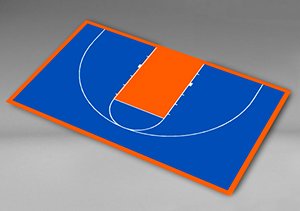
basketball court dimensions

H-1

21’W

x 25’L

basketball court dimensions

H-2

25’W

x 25’L

basketball court dimensions

H-3

31’W

x 26’L

basketball court dimensions

H-4

31’W

x 28’L

basketball court dimensions

H-5

31’W

x 31’L

basketball court dimensions

H-6

36’W

x 30’L

Half basketball courts

Many backyard basketball courts do have space for a full three point line.  The main question with these courts is, how much space do you need behind the three point line?  If your home basketball court does not have enough space behind the three point line, then your court may not be very playable.

basketball court dimensions

H-7

44’W

x 28’L

basketball court dimensions

H-8

46’W 

x 30’L

basketball court dimensions

H-9

49’W 

x 31’L

basketball court dimensions

H-10

59’W 

x 31’L

Full basketball courts

Full court basketball courts have different considerations than smaller backyard courts.  How much space do you need at midcourt?  To reduce the length of the court, the midcourt section can be smaller.  The other consideration is how much out of bounds space you need.  

basketball court dimensions

F-11

35’W x 65’L

basketball court dimensions

F-12

44’W x 75’L

basketball court dimensions

F-13

51’W x 84’L

basketball court dimensions

F-14

59’W x 95’L

facebook         site link…this is for seo purposes do not delete!!!!

BACKYARD BASKETBALL COURT FENCING

Most backyard basketball courts have fencing for ball containment.  No more knocking on your neighbor’s door to get your basketball that went over the fence!  No more chasing the basketball down the hill!  Fence heights range in height from 6′ to 10′.  The recommended fence height depends on the location of the court, any nearby obstructions, and if it is close to a busy street.  There are many options for fencing.  

The most popular option for basketball court fencing are our rebounders.  These are like chain link fences, but have soft mesh netting instead of metal links.  The mesh does not block view as much as chain links, and can be used as a practice wall for basketball or racquet sports.  Our rebounders come in two sizes – 10′ x 10′ and 10′ x 20′.  The most common setup is having one rebounder on each side of the hoop.  Multiple 10′ x 20′ rebounders can be used to cover a longer side, to protect the ball from going over the fence or down a hill.

rebounder
10'x 10' rebounder
rebounder
10' x 20' rebounder
BACKYARD BASKETBALL COURT CONSTRUCTION FAQs

There are many public basketball courts here in the Bay Area.  However, they can get very crowded, especially on the weekends or holidays.  Basketball is one of the most popular sports in school.  May customers choose to build their own backyard basketball court so their children and their friends can play in the safety of their own backyard.  Other customers build a backyard basketball court for the convenience of having a home basketball court.  Why drive to a crowded public basketball court when you can enjoy your own home basketball court?  Many families also have children in school playing for their school team, and having a backyard basketball court makes it easier for them to practice.  Some of our customers have even hired private coaches to come to their home and train their kids on basketball!  

The cost of a backyard basketball court is different for every home.  The starting point is the size of the court.  How much space do you have for your court?  How much site prep is required?  Is the area level, or will it need to be graded and leveled?  Dirt offhaul will also add to the cost.  In addition, access is very important.  We dig with an excavator.  If there is no access, then hand digging may be the only option.  This would increase the cost.

There are two ways to build a backyard basketball court.  If you are looking for a hardcourt, then the options are post-tension concrete and asphalt.  While post-tension concrete is a higher initial investment, it has many benefits.  It reduces the severity of cracks.  This gives post-tension courts an expected lifespan of 25+ years.  In comparison, asphalt cracks will tend to crack after 10 years or less.  Asphalt cracks easily becauseit shrinks over time.  Also it cracks due to the weather.  Also, asphalt becomes more brittle as it ages.  After asphalt courts start cracking, the cracks will tend to get worse over time.  The court will then need constant repairs over time.  As a result, asphalt courts may eventually need to be completely replaced.

In contrast to asphalt, post-tension concrete reduces or even prevents cracks.  Post-tension concrete is built with steel cables.  The cables are tensioned after the concrete is poured.  This keeps the concrete under compression in both directions.  This greatly reduces cracks.  As your local basketball court builder and basketball construction company, we focus on post-tension concrete.  Post-tension courts offer the best quality.  Also the total cost of ownership is lower when you factor in the lifespan of the court.

We are the exclusive dealer and court builder for Versacourt.  Versacourt is a leading basketball court tile company.  In contrast to acrylic hardcourts, tile courts can be built with rebar reinforced concrete.  However, there are many special considerations when building the concrete for a tile court.  If the concrete is not built correctly, the tile court will not perform well.  We have seen concrete done by “local concrete guys” which have resulted in soft spots in the court.  Basketballs will not bounce correctly on soft spots.  This results in poor bounce quality on your court, where some areas on the court bounce differently than others.  Most local concrete guys have never built a basketball court before.  Hire your local concrete guy at your own risk!  

The time to build a hardcourt backyard basketball court is about 6-7 weeks.  This is because we need to let the post-tension concrete cure for a full 30 days before the acrylic surface is applied.  The time to build a Versacourt tile court varies, depending on the Versacourt lead time.  In the busy season, the lead time to make the tile court is about 4-6 weeks.  In the less busy season, the lead time to make the tile court is about 3-4 weeks.

As far as the start date, that depends on you.  We require a signed contract and deposit to add your project to our queue.  We start projects in the order which we receive signed contracts.  So the sooner you make a decision, the sooner we can potentially start your project.

Court lighting is specialized and is thus different from most other kinds of lighting.  Court lighting faces straight down on the court.  This is important for many reasons.  When light is downward facing, you minimize glare.  Also, when lights face downward, this ensures even coverage of light across the entire court.

The higest governing body for basketball is the Federation Internationale de Basketball.  In the USA is called the International Basketball Federation.  This is shortened to FIBA.  Basketball is played at many levels, including international, professional, college, high school, and recreational.  Court dimensions will vary, however backboard dimensions and rim size remain the same.

Most home courts will have the standard NFHS court for school level play.  We can also add NCAA and NBA three point lines upon request.  For full courts and half courts, we can build courts in accord with NBA, NCAA, and FIBA standards.
CALL NOW